
The Fundamentals of Negotiation Every Business Owner Must Understand

Most business owners don’t think of themselves as negotiators. They think of negotiation as something that happens in boardrooms, in legal disputes, or in high-stakes corporate deals.
In reality, if you own and run a business, you negotiate every week. You negotiate with:
- suppliers,
- clients,
- landlords,
- staff,
- lenders,
- business partners, and
- occasionally with yourself.
The problem isn’t that owners don’t negotiate. It’s that many do it reactively, under pressure, and without stepping back to consider the commercial consequences. Over time, that quietly erodes margins, increases risk and limits strategic options.
Why Negotiation Matters Commercially
Negotiation is not about winning arguments. It’s about shaping outcomes. Done poorly, it affects:
Profitability: Discounting too quickly. Accepting unfavourable supplier terms. Overcommitting on scope. Each of these decisions erodes margins.
Time: Poorly negotiated agreements lead to disputes, misunderstandings and constant rework, which lands back on the owner’s desk.
Risk: Ambiguous terms and unbalanced agreements create legal, financial and reputational exposure.
Business value: A business that consistently negotiates from a position of weakness has lower profits and less resilience, which directly impacts valuation.
For owners thinking about scalability, succession or eventual exit, negotiation capability is not optional. It’s part of a disciplined business strategy and value protection.
Principle 1: Don’t Negotiate When Under Pressure
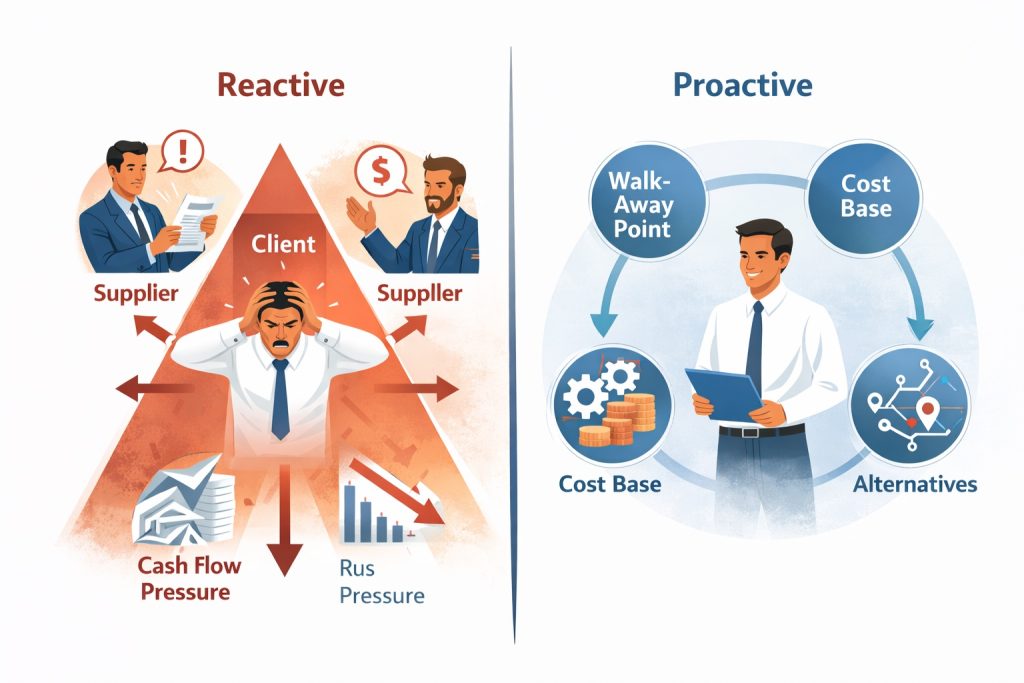
What owners commonly get wrong is negotiating when they’re cornered. A large client threatens to walk. A supplier increases pricing unexpectedly. Cash flow tightens. Under pressure, concessions are made quickly to ‘keep things moving’.
Well-run businesses understand leverage. They prepare before conversations happen:
- They know their walk-away point
- They understand their true cost structure
- They assess alternatives before entering discussions.
Preparation creates options. Options create strength.
If you’re constantly negotiating under pressure and without adequate preparation, you are leaving money on the table.
Principle 2: Understand the Other Party’s Position – But Protect Your Own
Negotiation advice often focuses heavily on understanding the other side. That matters. But many owners overcorrect and prioritise being ‘reasonable’ over being commercially disciplined.
Strong negotiators clarify:
- What matters most to the other party
- What matters most to them
- Where trade-offs are acceptable – and where they are not.
For example, you might concede on timing but not on price, or on flexibility but not on liability. Without clarity on your own commercial priorities, negotiation becomes reactive. This is why negotiation must align with your broader business strategy and financial realities, not just relationship management.
Principle 3: Margin Protection is a Leadership Responsibility
Many owners avoid difficult pricing conversations because they value relationships. That instinct is understandable. But consistently conceding on price or scope sends a signal to the market and to your team.
Well-run businesses:
- Price with intention
- Communicate value clearly
- Avoid unnecessary discounting
- Enforce scope boundaries.
This protects profit quality.
If you habitually discount to secure work, you’re not just reducing margins – you’re setting a precedent that becomes difficult to reverse. Over time, this shapes the type of clients you attract and the culture you build.
Principle 4: Document Agreements Clearly – Even When Trust Is High

In smaller businesses, long-standing relationships often rely on verbal agreements and goodwill. Trust is valuable. But ambiguity is expensive.
Owners commonly assume:
- ‘We’ve worked together for years – it will be fine.’
- ‘We’ll sort it out if there’s an issue.’
Strong businesses formalise expectations clearly:
- Scope of work
- Payment terms
- Responsibilities
- Exit conditions.
Clarity reduces disputes, protects cash flow and limits legal risk. It also reduces owner involvement in conflict resolution, which improves lifestyle and scalability.
Principle 5: Negotiation Should Strengthen Relationships, Not Strain Them

There is a misconception that firm negotiation damages relationships. In reality, poorly handled negotiation damages relationships far more than clear, respectful boundaries.
Effective negotiators:
- Separate people from the issue
- Stay calm under pressure
- Focus on facts and outcomes
- Avoid emotional escalation.
When handled properly, negotiation strengthens mutual respect. This is particularly important for owner-operated businesses where reputation and long-term partnerships matter.
Principle 6: Develop Negotiation Capability Across the Team

If every meaningful negotiation runs through you, you remain the bottleneck.
Owners often retain negotiation authority because they fear others will concede too easily or mishandle discussions. That fear is sometimes justified, but it also signals a capability gap.
High-performing businesses invest in developing commercial judgement across their leadership team. They clarify:
- Negotiation boundaries
- Authority levels
- Non-negotiable standards.
This reduces dependency on the owner and strengthens the business’s operating maturity.
In evolving markets, this capability directly links to innovation and strategic adaptability, with commercial discussions shaping future opportunities.
What This Means for You as an Owner
If you are:
- frequently absorbing margin pressure,
- personally involved in every major commercial discussion,
- managing recurring disputes or misunderstandings, or
- concerned about long-term business resilience;
Then negotiation capability deserves your attention.
Improving negotiation outcomes is not about becoming aggressive. It is about becoming structured, prepared and commercially disciplined. Over time, this strengthens:
- Profits
- Cash flow predictability
- Relationship stability
- Business value.
A Measured Next Step
At Fortitude Business Consulting, we work with owner-operated businesses to strengthen commercial discipline, including pricing strategy, contract clarity and negotiation positioning.
Negotiation is rarely the headline issue. But it often reveals deeper structural gaps in strategy, risk management and operational alignment.
If your negotiations consistently feel harder than they should, it may be worth reviewing whether your strategic positioning and internal clarity are supporting you or undermining you.
Like most aspects of business performance, stronger negotiation outcomes begin with clearer thinking and deliberate preparation.
If you’d like help stepping up your negotiation skills, call Fortitude Business Consulting on 1300 551 040.