
Employee Recognition & Feedback: The Leadership Skill Most Managers Underuse

Most business owners don’t avoid giving feedback because they don’t care. They avoid it because:
- they’re busy,
- it feels awkward,
- everything seems ‘fine’, or
- because past conversations didn’t go as they hoped.
As a result, feedback gets delayed, softened, or skipped altogether. Recognition becomes occasional, informal, and vague. And over time, standards quietly drift.
For owner-operated businesses, this isn’t just a leadership issue. It’s a commercial risk that directly affects performance, retention, owner workload and long-term business value.
The Owner Reality: When ‘They Should Know’ Becomes a Problem
Many owners assume their expectations are obvious. After all, you know what good looks like. You’ve built the business. You see the issues immediately. You feel the cost when something isn’t right.
But your team doesn’t live in your head. When recognition and feedback are inconsistent, people start guessing:
- What actually matters?
- Where they should focus their efforts?
- Whether they are doing a good job or just enough to stay out of trouble?
That uncertainty shows up as hesitation, over-escalation, and underperformance, which quietly pulls the owner back into the centre of everything.
Why Recognition and Feedback Matter Commercially
Handled poorly (or not at all), recognition and feedback create real business costs:
Profitability: Inconsistent performance leads to inefficiency, errors, rework and margin leakage.
Risk: Good people disengage or leave. Knowledge walks out the door. Capability gaps widen.
Business Value: A business that relies on the owner to set standards informally is harder to scale, delegate, and exit.
This is why recognition and feedback aren’t ‘nice to have’. They are part of the operating system of a well-run business.
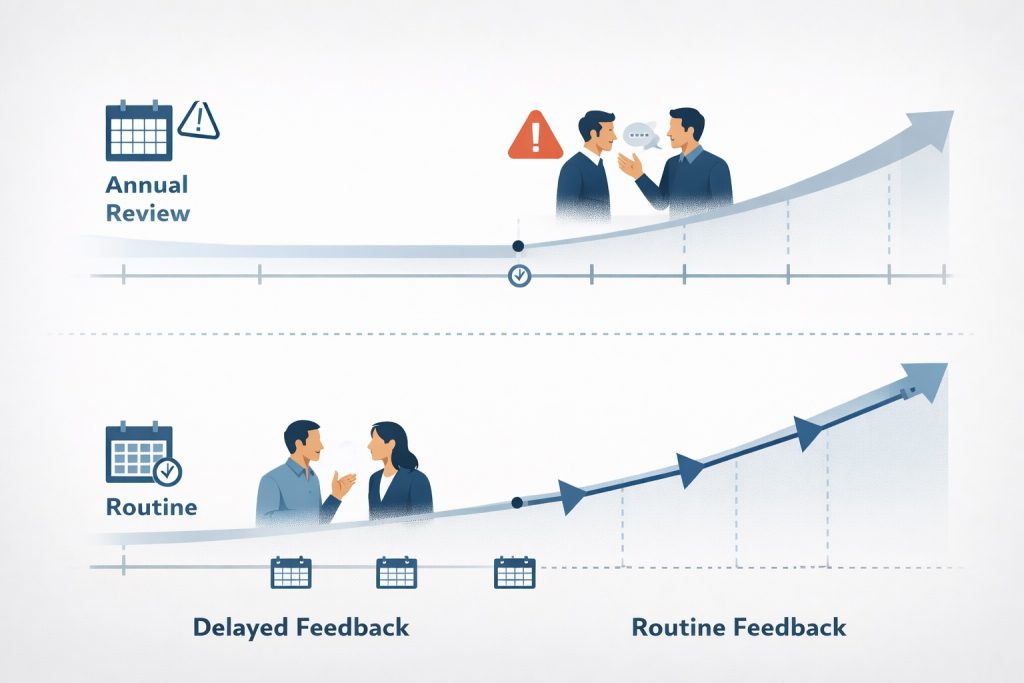
Principle 1: Most Owners Wait Too Long to Give Feedback
What owners commonly get wrong is timing. Feedback is often saved for:
- Annual reviews
- Performance issues
- Moments of frustration.
By then, the impact is diluted or emotional.
Well-run businesses treat feedback as routine, not reactive. Expectations are reinforced early, while adjustments are small and easy to make. The commercial outcome is simple: fewer problems compound, and standards stay where they belong. This level of consistency is a hallmark of strong business strategy and execution, not micromanagement.
Principle 2: Recognition Must be Specific to Drive Performance
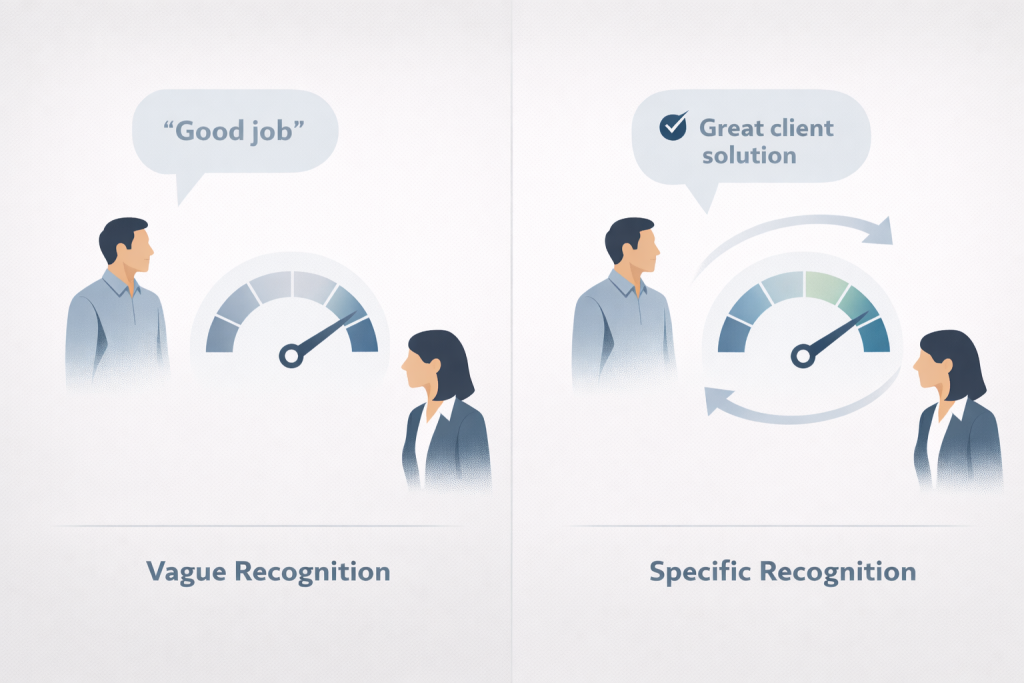
Many owners believe they recognise their team because they say things like:
- ‘Good job’
- ‘Thanks for that’
- ‘Appreciate the effort’.
The intent is positive, but the impact is limited.
High-performing businesses are more deliberate. Recognition is tied to:
- Specific outcomes
- Specific behaviours
- Clear standards.
This tells people exactly what to repeat.
When recognition reinforces the right actions, performance improves without constant oversight – reducing owner dependency over time.
Principle 3: Feedback Isn’t About Motivation – It’s About Clarity
Owners often avoid feedback because they don’t want to demotivate someone. In reality, unclear expectations are far more damaging than direct, measured feedback. Well-run businesses separate:
- The person
- From the standard.
Feedback focuses on:
- What’s expected
- Where performance sits
- What needs to change.
This creates certainty, which allows people to operate confidently without checking everything with the owner. This shift is often where an experienced business advisor’s support helps owners reset patterns that have crept in over time.

Principle 4: Feedback Protects You From Being the Bottleneck
When feedback is rare or vague, decisions drift upward. People escalate because they’re unsure. They seek reassurance instead of exercising judgement. The owner becomes the filter for quality and risk.
In strong businesses:
- Decision boundaries are clear
- Feedback reinforces judgement, not dependence
- Owners intervene less, not more.
Over time, this frees capacity for higher-value work on strategy, growth, and risk management, etc., rather than on constant supervision.
Principle 5: Recognition and Feedback are Key to Retention and Value
Good people don’t just want to be paid. They want to know:
- Where they stand
- Whether they’re trusted
- Whether their contribution matters.
When recognition and feedback are consistent, people stay engaged longer and capability becomes embedded in the business, not individuals. This matters for owners thinking about:
- Succession,
- stepping back, or
- eventual exit.
A business with stable, accountable teams is simply worth more.
Principle 6: Feedback Must be a System, Not a Mood
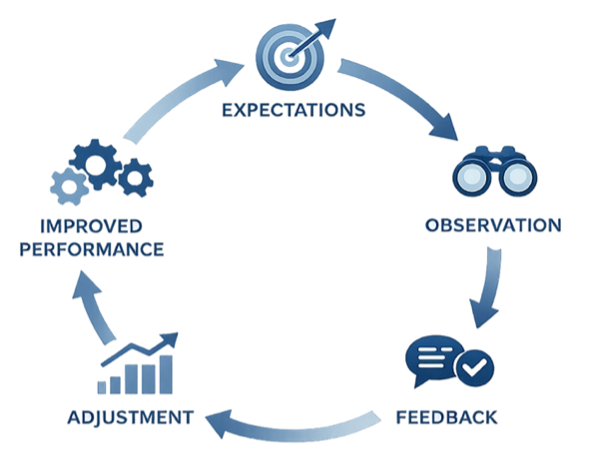
In many owner-operated businesses, feedback depends on how busy or stressed the owner is. That unpredictability creates inconsistency.
Well-run businesses build feedback into normal operations through:
- Regular check-ins
- Clear performance expectations
- Ongoing course correction.
This aligns closely with continuous improvement and innovation, where small adjustments prevent large problems.
What This Means for You as an Owner
If you find yourself:
- Re-explaining standards repeatedly
- Holding in frustrations you haven’t voiced
- Not addressing performance issues in a timely manner.
Then recognition and feedback aren’t just being underused – they’re being under-systemised. This isn’t about becoming a different kind of leader. It’s about being more deliberate with the leadership you already provide.
A Measured Next Step

At Fortitude Business Consulting, we work with owners who want their businesses to perform consistently – without relying on constant intervention.
Recognition and feedback are rarely the problem that owners believe they have. But they are often the lever that unlocks better performance, lowers risk and creates a more scalable business.
If this resonates, it may be worth stepping back and asking whether the way expectations are set and reinforced in your business are supporting the outcomes you actually want.
That reflection is often where meaningful improvement begins.
If you’d like help embedding recognition and feedback into your business, call Fortitude Business Consulting on 1300 551 040.